

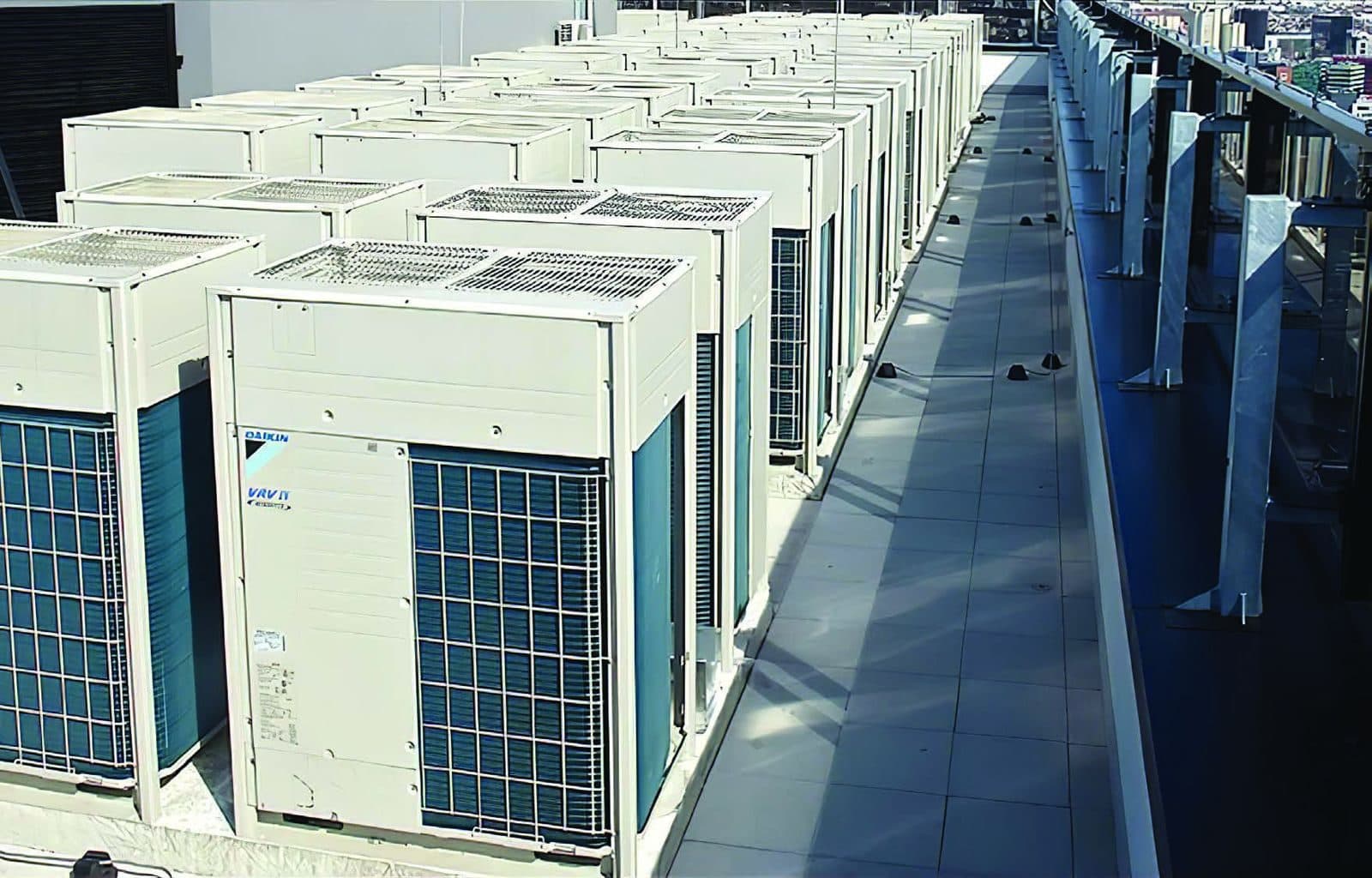
- There's no universally best system — the choice depends on building size and use.
- Chillers suit large buildings and campuses with high, continuous loads.
- VRF is flexible and efficient for medium, multi-zone buildings.
- DX is economical for small, standalone spaces.
- Compare life-cycle cost, not just installation cost.
In Saudi Arabia's climate, air conditioning accounts for most of the electricity used in many buildings, so the system choice affects the owner for the building's whole life, not just during construction. Here are the three most common systems and when each fits.
Chillers
A chiller cools water centrally; chilled water is then pumped through pipework to air-handling units (AHUs) and fan-coil units (FCUs). Chillers can be air-cooled on the roof or water-cooled with cooling towers.
- Fits: large buildings, hospitals, malls, universities and high, continuous loads.
- Strengths: high efficiency at large loads, long service life, good control of air quality and fresh-air rates.
- Considerations: higher capital cost; needs a plant room, pumps and pipework, and a specialised operation and maintenance team.
VRF (variable refrigerant flow)
One or more outdoor units serve many indoor units through refrigerant piping, varying the refrigerant to each unit as needed so each zone can run independently.
- Fits: offices, hotels, residential and medium commercial buildings with many zones.
- Strengths: good part-load efficiency, room-by-room control, no large plant room.
- Considerations: limits on pipe lengths and height differences; a large refrigerant charge inside the building needs safety-aware design; fresh-air ventilation needs a complementary solution.
DX (direct expansion)
Includes split and package units. Cooling happens directly with refrigerant inside the unit, without chilled water.
- Fits: small, standalone spaces, shops, villas and warehouses with limited loads.
- Strengths: lowest capital cost, quick installation, easy maintenance.
- Considerations: lower efficiency in large buildings, many outdoor units, limited air-quality control.
Quick comparison
- Capital cost: DX lowest, then VRF, then chillers.
- Efficiency at large loads: chillers usually lead.
- Flexibility and zone control: VRF.
- Plant space: chillers need the most.
- Ease of maintenance: DX easiest; chillers need a specialist team.
The right decision rests on a proper heat-load calculation and life-cycle cost analysis — not on what's most popular or cheapest.
How to decide
- Calculate heat loads accurately for each zone rather than relying on per-square-metre rules of thumb.
- Define the usage pattern: operating hours, part-load operation, independent zones.
- Check the space available for plant on the roof and in technical rooms.
- Compare life-cycle cost: installation, energy, maintenance and replacement over 15–20 years.
- Confirm compliance with the Saudi Building Code and energy-efficiency requirements.
FAQ
Which uses less electricity: VRF or chillers?
It depends on building size and operation. Chillers usually win in large buildings with continuous loads; VRF is very efficient in medium, multi-zone buildings with part-load operation.
Can one building combine systems?
Yes, and it's common: chillers for main areas with DX for server rooms or standalone zones, or VRF with dedicated fresh-air units.
How long does a central HVAC system last?
It varies by type and maintenance quality. Large equipment such as chillers typically outlasts small units, and regular maintenance is the biggest factor in service life.
Engineers and specialists in government tenders, technical office, MEP and central HVAC, with more than 15 years in the Saudi market.